
Culture & Ethnicity
Exploring culture, race, ethnicity, and belonging in Asia.

Culture & Ethnicity Overview
About 1 in 12 people in Hong Kong belong to an ethnically diverse community. Their families helped build this city: the Star Ferry, the first banknotes. Yet school history textbooks barely mention them. That absence has a cost.
When a city doesn’t know your grandfather guarded its borders, it keeps asking where you’re really from. Even third and fifth generation Hongkongers who speak perfect Cantonese get treated as guests in the only home they have ever known. This ‘Voice’ closes that gap.
We tell the history that was always there, name the everyday slights that grow from not knowing it, and give workplaces and schools the words to do better. The young people carrying this heritage forward are not outsiders. They are the Voices of Tomorrow.
“Did You Know?” Quiz
Stories about Culture & Ethnicity
A common tension: Zain's Homecoming
After two weeks of honking and noise in Pakistan, I was finally heading home. Yes, home: Hong Kong. I’m a Pakistani Hongkonger. I didn’t grow up around my relatives back there, and I barely remember my cousins’ names.
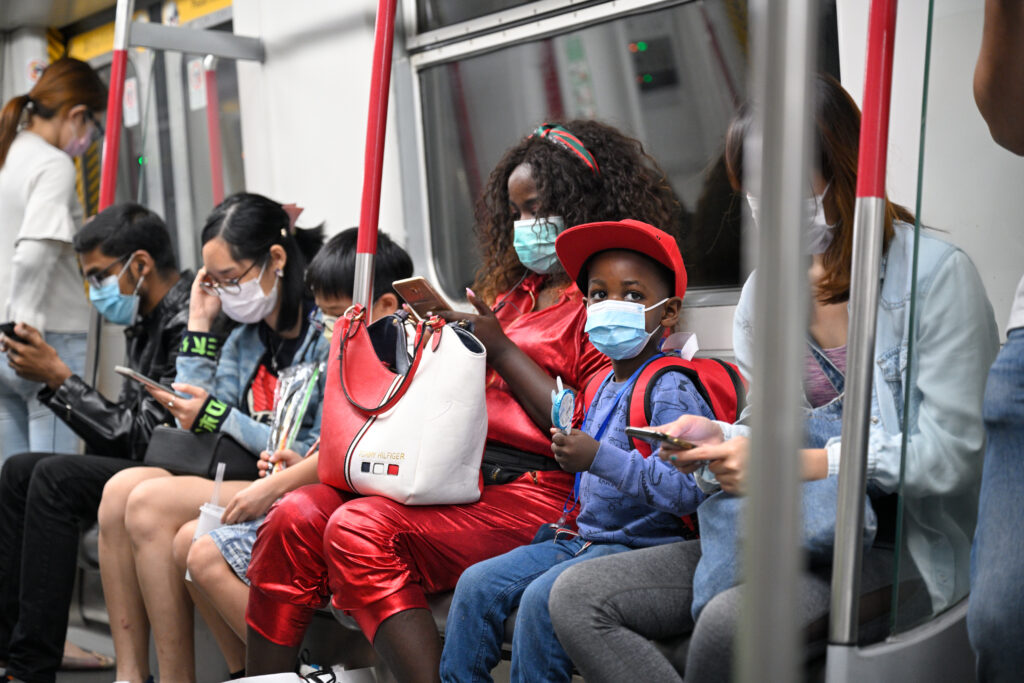
The moment I landed, I texted my friends to play football. On the MTR to To Kwa Wan, I found an empty seat and sat down. The woman next to me got up and moved to the opposite row.
Panic hit. Do I smell? No. I’d showered, and I hadn’t even played yet. Then it landed: it wasn’t me, it was my skin. Why is my colour a trigger for exclusion? I thought of the COVID rumours about South Asians, of my own neighbours stepping out of the lift when I stepped in.
At the pitch my friends laughed at the story, but their eyes held that heavy, familiar resonance. Microaggressions add up. Next time, I’ll just stand.
What's going on here?
The woman repeatedly moving away from Zain is a form of painful social distancing. Treating his body as if it’s dirty, dangerous, or diseased just because of his skin colour turned an ordinary MTR ride into a public rejection. Why it matters: this kind of quiet avoidance happens to ethnic minorities in Hong Kong every day, and it got worse during COVID-19, when rumours falsely blamed South Asians for spreading the virus. Neighbours avoiding your lift, strangers moving seats: it wears down self-esteem over time and makes people feel unwelcome in their own home. What people miss: brushing this off as an awkward coincidence lets a bigger pattern continue unchallenged. It isn’t one moment, it’s a daily microaggression that quietly strips ethnic minorities of the basic dignity of moving through public space.
A mundane hidden challenge: Gabby & Rizwan's Flat Hunt
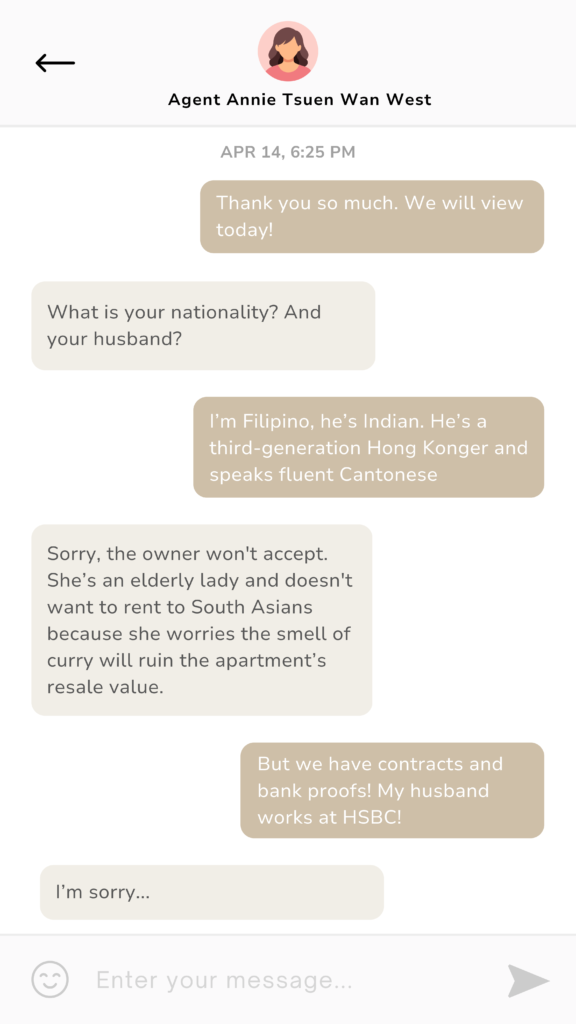
Agent: “What’s your nationality? And your husband’s?”
Gabby: “I’m Filipino, he’s Indian. He’s a third-generation Hong Konger, fluent Cantonese.” She led with it, the way we always do now, bracing.
Agent: “Sorry, the owner won’t accept. She doesn’t want to rent to South Asians. She’s worried the curry smell will hurt the flat’s value.”
Gabby: “But we have proof of employment, bank proof. My husband works at HSBC!”
Agent: “I’m sorry…”
It’s 2026, and yet this still happens. We stayed put and swallowed our own landlord’s rent hike, just to avoid the trauma of flat-hunting while ethnic minority in Hong Kong.
What's going on here?
The landlord discriminated outright, refusing to rent based on ethnic stereotypes, and the agent acted as an enabling gatekeeper, normalising an unlawful request rather than pushing back. Why it matters: finding safe, dignified housing is a basic need. In Hong Kong, ethnically diverse tenants face systemic rejection from landlords regardless of income, profession, or language, often pushed into worse housing or overpriced subdivided flats as a result. What people miss: some assume private property rights let a landlord screen tenants by race. In reality, Hong Kong’s Race Discrimination Ordinance makes it unlawful for a landlord or agent to refuse a tenancy on ethnic or racial grounds.
An ally's lens: Allison's Mooncake Swap
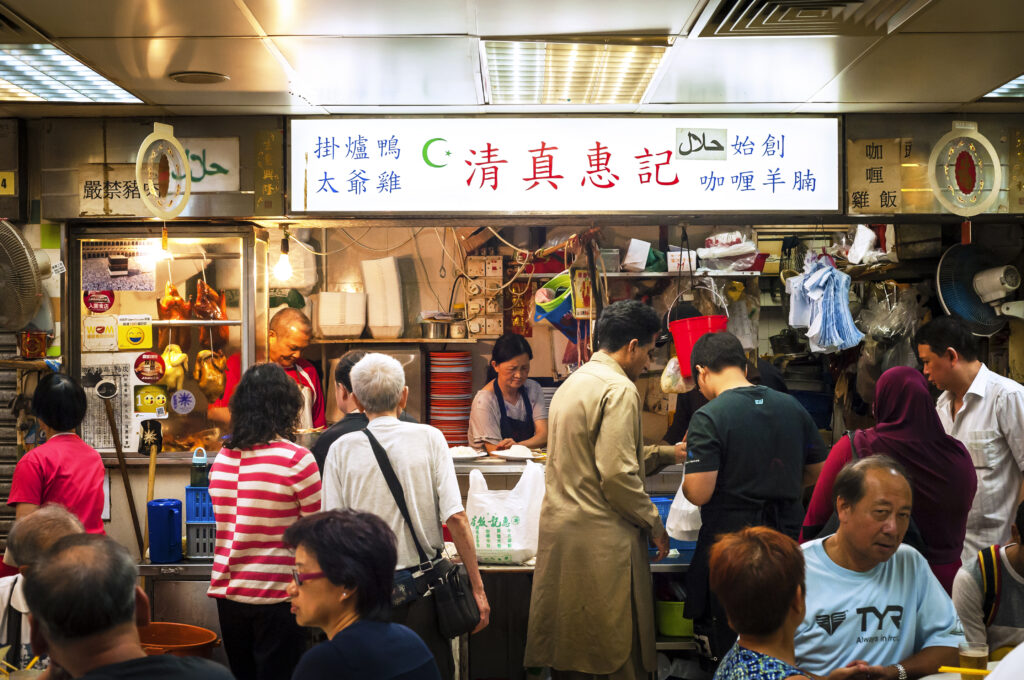
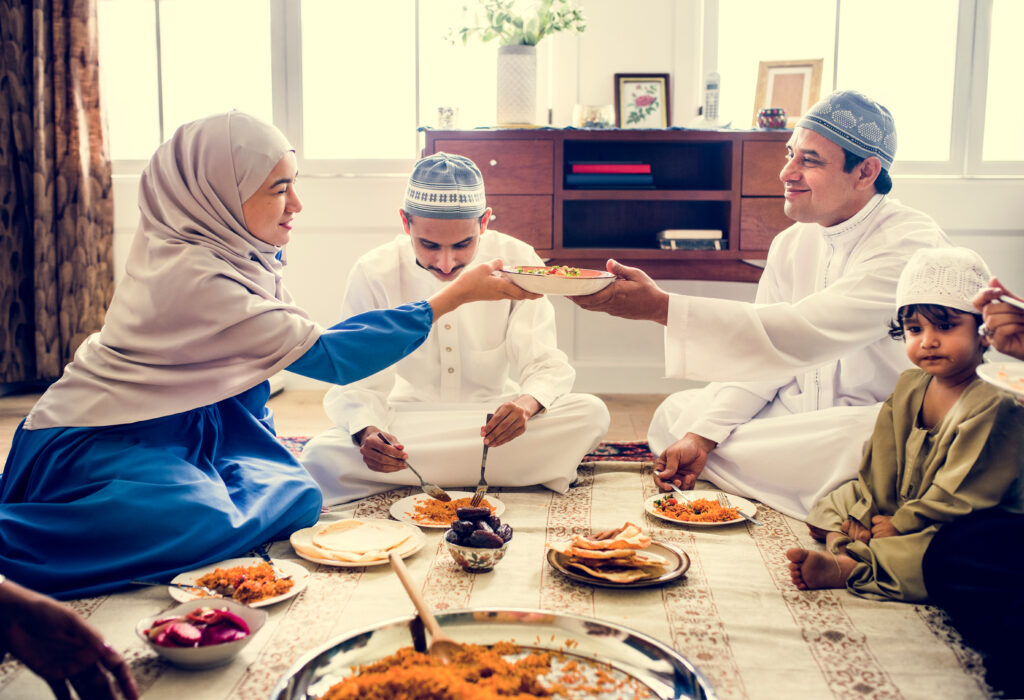
During the Mid-Autumn Festival, our manager, Mr Lau, instructed the admin team to buy mooncakes for the staff. As a vegetarian, I immediately thought about our team’s dietary needs. My Muslim colleagues, Ali and Hawa, would need vegetarian, or ideally, halal-certified options. I did some quick research and sent Ms Lee, my supervisor, links to local halal bakeries.
Unfortunately, Mr Lau had already insisted on a specific traditional shop: one whose mooncakes use pork lard as an oil base, making them completely non-Halal. When I raised this, Ms Lee sighed and said it was too late to change the order.
The next day, Ali politely accepted his box but left it untouched on his desk. Hawa was off, so her box sat there too. I gave mine to Ms Lee to avoid waste. This made me feel incredibly uneasy. How can we claim to be inclusive when we leave people out of basic workplace celebrations?
That evening, I went out and bought three boxes of Halal-certified vegetarian mooncakes: one for myself, one for Ali, and one for Hawa. Early the next morning, I quietly swapped the boxes on Ali and Hawa’s desks.
What's going on here?
Management dismissed clear, pre-emptive feedback about dietary restrictions, choosing corporate convenience over basic religious and cultural inclusion. Forcing Muslim employees into a position where they must politely accept a gift made with pork lard, something entirely forbidden in their faith, is deeply exclusionary. Why it matters: in Hong Kong’s corporate culture, festive gifting is a major ritual meant to build team cohesion. When managers treat dietary requirements like Halal or vegetarianism as difficult personal preferences rather than core identities, workplace celebrations turn into moments of alienation for ethnic and religious minorities. What people miss: many believe inclusion simply means ensuring everyone receives a physical box, focusing on the optics of giving. True inclusion is about equal respect; expecting a colleague to quietly fix the mistake behind the scenes proves that minority needs are still treated as an afterthought.
Key Terms
Race: A social classification based mainly on physical traits: skin colour, facial features, hair. Society uses it to sort people, but it has no real biological basis. Examples: Black, White, Asian, Indigenous.
Ethnicity: A shared cultural identity built on common ancestry, language, history and tradition. Where race is about how you look, ethnicity is about the group and heritage you belong to. Examples: Han Chinese, Punjabi, Gurkha/Nepali, Irish.
Nationality: Your legal relationship to a country: the passport you hold and where you have citizenship rights. Purely political and legal; it says nothing about your race or ethnicity. A Pakistani Hongkonger can be Chinese by nationality, holding an HKSAR passport.
Ethnic Minority: The official term in Hong Kong for anyone of non-Chinese ethnicity: about 8.4% of the city, or 4.1% once foreign domestic helpers are set aside. It covers South Asian, Southeast Asian, East Asian, and Western communities, not just South Asian. Because “minority” implies outsider, people assume recent migrants, but most are third- or fourth-generation Hongkongers.
NCS + NEC: Two official labels: Non-Chinese Speaking (NCS) and Non-Ethnic Chinese (NEC). However, both are defined by what they lack, not what they bring.
Social & Upward Mobility:The chance to move up through education and fair hiring into better work. In Hong Kong, language barriers and quiet hiring bias act like a glass ceiling, keeping talented young people from diverse backgrounds stuck in low-paid jobs.
Latest resources in this Voice
How-to-Say Guide: Culture & Ethnicity
The words are the hard part. Here are three you can borrow.
Fate Disrupted | Jeffrey Andrews | TEDxTongChongSt (opens in a new tab)
A 15-minute watch that puts a human face on the census data. Hong Kong's first locally-qualified ethnic minority social worker balances the numbers with…
EOC: All Races as One (opens in a new tab)
Secondary-school learning kit: slides, timelines, RDO teaching points, classroom-ready.
Want to know who's doing the good work in this space?
Explore organisations and service providers working in culture & ethnicity, vetted and part of our Directory.